
microPAM-pico hardware#
Work in progress
KB2040#
This paricular implementation uses the Adafruit kb2040, that is smaller than the original RP 2040 pico.
Bill of Materials#
As of 09-Oct-2024 the microPAM-pico could consist of the following components (34.90 USD)
Component |
Source |
Product |
Price |
|---|---|---|---|
MCU: kb2040 |
Adafruit |
Product ID: 5302 |
8.95 USD |
Microphone: I2S MEMS |
Adafruit |
Product ID: 6049 |
4.95 USD |
uSD Card holder |
Adafruit |
Product ID: 4682 |
3.50 USD |
RTC clock |
Adafruit |
Product ID: 3013 |
17.50 USD |
USB Powerpack |
TBD |
TBD |
TBD |
Wiring#
A potential kb2040 based microPAM could be wired like this

kb2040/RP2040 based prototype#
A potential Adafruit kb2040 based microPAM could look like this

with the dimension 58 x 46 mm
This prototype uses some different components: the Adafruit I2S MEMS is relaced with a ICS-43432 microphone from Peski, and the SD card holder is from Sparcfun “SparkFun microSD Transflash Breakout” “BOB-00544” for 5,50 USD
RP2040 based prototype#
A microPAM recorder with a standard rp2040 could look like this, here using a custom made ICS-4332 microphone und wired on the fly (not visible on the back of the board)

Adalogger based prototype#
The Addafruit Rp2040 Feather logger board includes microSD card and LItium battery loader. By adding a RTC Featherwing and a ICS43434 MEMS microphone a very compact macoustic recorder may be constructed.

While the Adalogger based system will run with the microPAM_V3 software, a simplified version is available under the adalogger folder WMXZ-EU/microPAM. In addition to this c++ program, there is in WMXZ-EU/Adalogger a python program based on CircuitPython.
Power consumption#
Using the C (Arduino) version of the logger, the power consumption is about 100 mW for revording with a sampling frequency of 48 kHz and full 32 bit data.
Bill of Materials#
As of 18-Dec-2024 the microPAM-logger could consist of the following components (33.85 USD)
Component |
Source |
Product |
Price |
|---|---|---|---|
MCU: Adalogger rp2040 |
Adafruit |
Product ID: 5980 |
14.95 USD |
RTC clock |
Adafruit |
Product ID: 3028 |
13.95 USD |
Microphone: I2S MEMS |
Adafruit |
Product ID: 6049 |
4.95 USD |
USB Powerpack |
TBD |
TBD |
TBD |
Construction#
The construction of the microPAM-adalogger uses the fact that the RTC feather wing duplicates the pins of the Feather board. This allows simply wired connections for the I2S microphones without further PCB boards. The MEMS microphone may then be placed in an appropriate position (close to the housing, behind a small opening to allow sound to enter) The outside row of the Featherwing can then be used to hold the Adalogger RP2040 Feather.
The following schematic shows the wiring
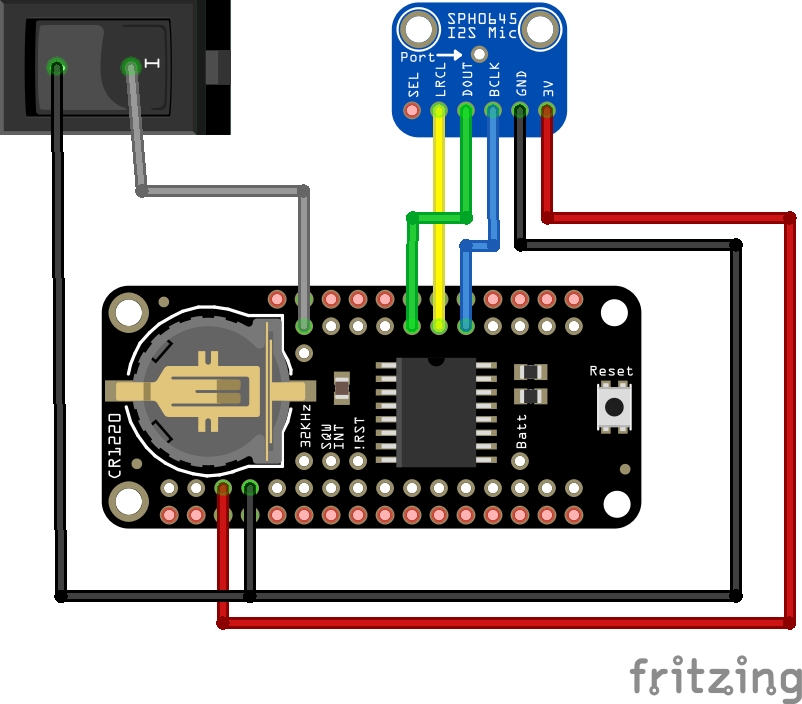
In addition the the MEMS microphone, the schematic shows a simple switch that allows the Enable Pin of the Feather board to be connected to ground. By doing so, the Feather board is disabled, and power consumption is minimized (not reall zero, but very low). Opening the switch will start the processor.
Examples of a real implementations#
The following pictures show RP2040 based microPAM implementation of Jonas Baumgärtner, University of Applied Science Dresden, for bachelor thesis and the microPAM in action with solar panel at Neusiedler See (Austria) to research the autumn bird migration by flight calls.


The microPAM adalogger implementation was recently be used to record urban soundscapes in La Spezia, Italy as part of STEM activities
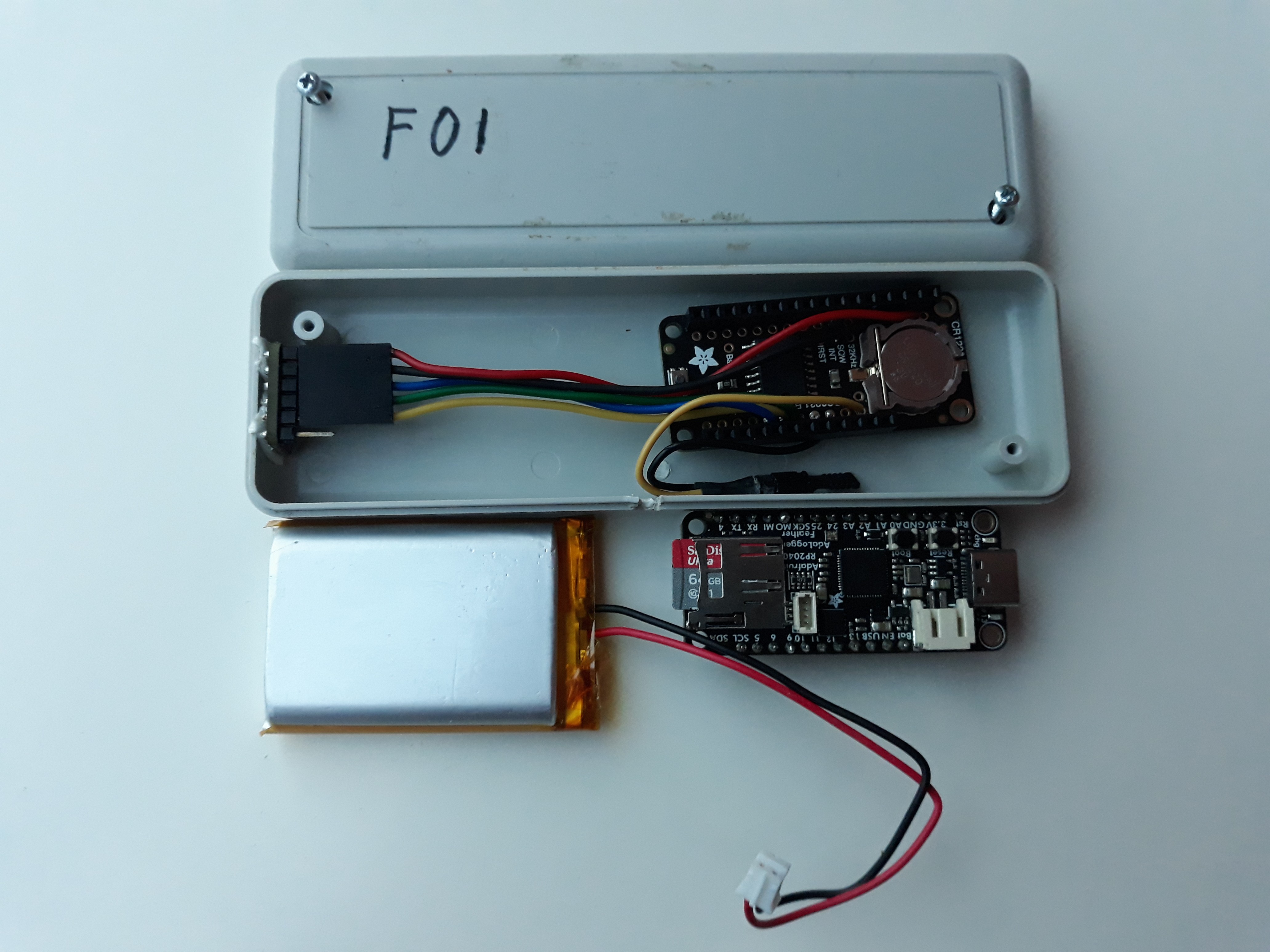
The wholes packages was included in a small plastic box and the 2Ah Lithium battery lasted over 3 days of continuous recording at 48 kHz. The Microphone was taped to a small hole in the box.